
 More charts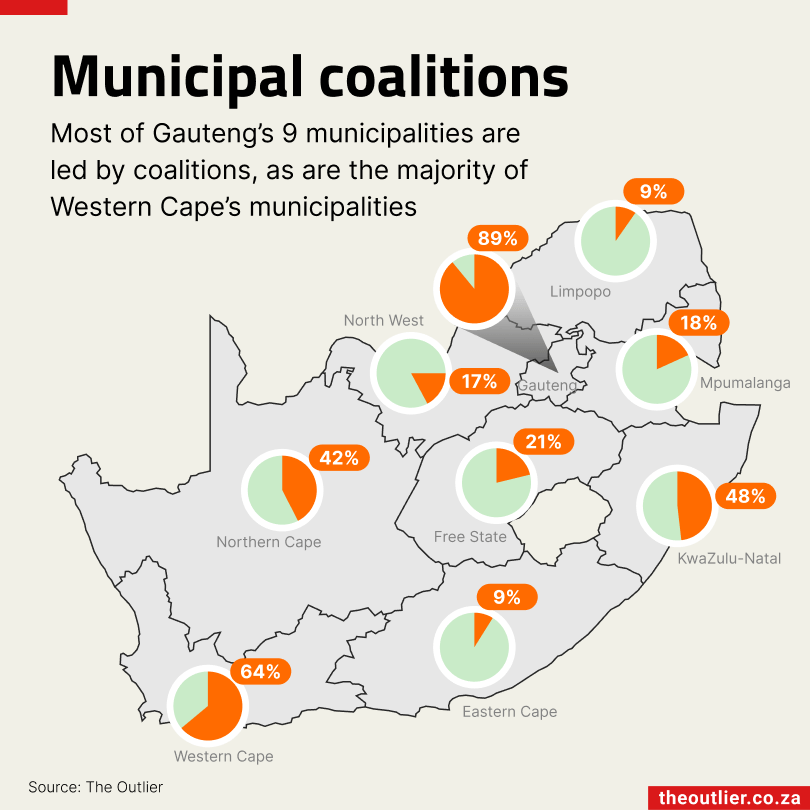
With the ANC losing its outright majority in the South African elections held in May, a so-called government of national unity has been formed to govern for the next five years.
While this kind of power-sharing may be something new for the national government, many of the country’s local municipalities have had coalition agreements in place since the local government elections in 2021.
Almost one-third of South Africa’s municipalities had no party with a clear majority after the local poll so they are governed by parties who have agreed to work together.
Of the 213 local municipalities and metros in South Africa, 71 have coalitions. Most of Gauteng’s municipalities are coalitions (89%), as were the Western Cape’s (64%).
In Gauteng, three of the province’s metros are coalition governments: Johannesburg, Tshwane and Ekurhuleni. Of these, Joburg has had the most mayoral changes – no less than five – since November 2021.
The Eastern Cape and Limpopo have the fewest coalition municipalities, with only 9% of each province governed through some form of power-sharing.